
Disrupting Beer with Stan Hieronymus

 A writer recently characterized as doing “more to advance our understanding of beer than anyone in the past decade” calls St. Louis his home. No matter where he travels for festivals, writing or just to sample the brews, Stan Hieronymus is at the vanguard of a trend to celebrate the local ingredients, local environment, and local techniques that make each beer unique. He’s writing the upcoming book Brewing Local.
Beer—art or science?
It’s neither, it’s agriculture. You should understand the science, but if you want to connect and create new, it’s an art. Hops are different by the day they were harvested sometimes, grains and malts change by season and location. You have to understand the ingredients.
What does beer have to do with modern life?
There’s something about beer that appeals to people. It’s more working man, more accessible than wine. It’s something seen as from a simpler time, and in complicated times, people want to return to it. And people love to connect to the people and the process.
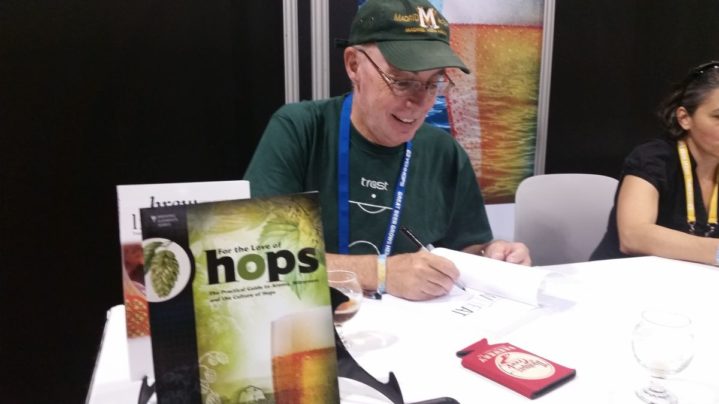
Tell us about the photo you sent for use with this story—where did you take it?
It’s me signing books at this year’s Great American Beer Festival.
Where do you get inspiration?
I’m inspired by the history of brewing and connecting to brewers. That comes in spending time with them, reading technical and history books, and writing. Writing inspires me because it’s a means to an end—it forces me out to collect information that I can share with people.
What does “local” mean?
There are levels of local. In the case of beer, ingredients can be sourced local to the brewery or from a distance. Where did the recipe, the hops, the grains, the water, the adjuncts and the yeast come from? The more local something is, the more connected it is to the people, time and place.
Beyond education or training, what prepared you for what you’re doing now?
Daria and I quit our regular jobs in 1992 without much of a plan, just a desire to see more of the country and support ourselves through freelance writing. We went to Florida to camp and Daria got a job writing about the brewpubs of Florida for American Brewer—there were six of them—and because I was a home brewer, I asked a lot of questions. That’s really led me to where I am today.
What do you struggle with the most?
Focus. One of the chapters in the book is about foraging for yeast—like the mixed fermentation beers today, and the way people brewed until just 100 or 150 years ago. I could lose myself in just that topic for six months.
What is the thing most people don’t get at first about what you do?
That it’s not just about drinking beer. I do taste a lot of beer, but it’s as much about people and process as it is about the beer. Process is a great way to tell the story.
When you’re gone, what do you hope your contribution will have been?
If anything, I hope people remember me as accurate and generous. What I do is put resources together—there are a lot of made-up stories in beer, so accuracy is a big deal. There’s a culture in beer that I hope I’m contributing to.
Who are your favorite artists, writers or musicians?
I’m really into music. When we quit our regular jobs, for three years we did a newsletter called Music Festival News, which featured a lot of bluegrass. I love James McMurtry, Robert Earl Keen—they can tell a story in 2 ½ minutes, like “The Road Goes On Forever and the Party Never Ends” about the couple that robs people and the guy takes the fall so she can live with the money.
I could go to music festivals on weekends and write about them, and I did, but you can write about beer all week long, so that became my job.
What current problem would you like to solve?
I’d love to see us reach homeostasis—balance between population and ability to feed it—but I don’t know how.
Favorite guilty pleasure?
Driving. Yesterday we drove down to Scratch Brewing outside Carbondale. It’s flat and uninteresting part of the way but interesting the last half of the trip. They forage for local ingredients to add really local and seasonal flavors. For example, Persimmons from a tree are bitter, ones from the ground are sweet if you can get them before the critters do. Scratch has been there long enough to know how to find things year round, like the roots that add bitterness if you don’t have hops.
How can people follow you (twitter, blog, events, etc.)?
I’m on twitter at @StanHieronymus or check out my past books.
Posts in Spotlight Z

Not a Crap Idea: Qstodian Platform is Well-Positioned to Keep Developing Ingenious Solutions for a “Boring” Industry
Qstodian Helps Venues Flush Custodial Costs Down the Drain
CheckTheQ Pivots Product, Re-brands as Qstodian After Actively Listening to Customers

Pluton Biosciences Successfully Raises $98,000 via Nvsted Regulation Crowdfunding Platform

St. Louis Investor Commits $100,000 to Expand VoiceXP Platform